
Enthusiasts explore extreme power management for high-end home computing
Community hardware hobbyists are sharing specialized techniques for managing the electrical demands of next-generation computer components.
By WKNA 49 Newsroom • June 25, 2026 • WKNA 49 News
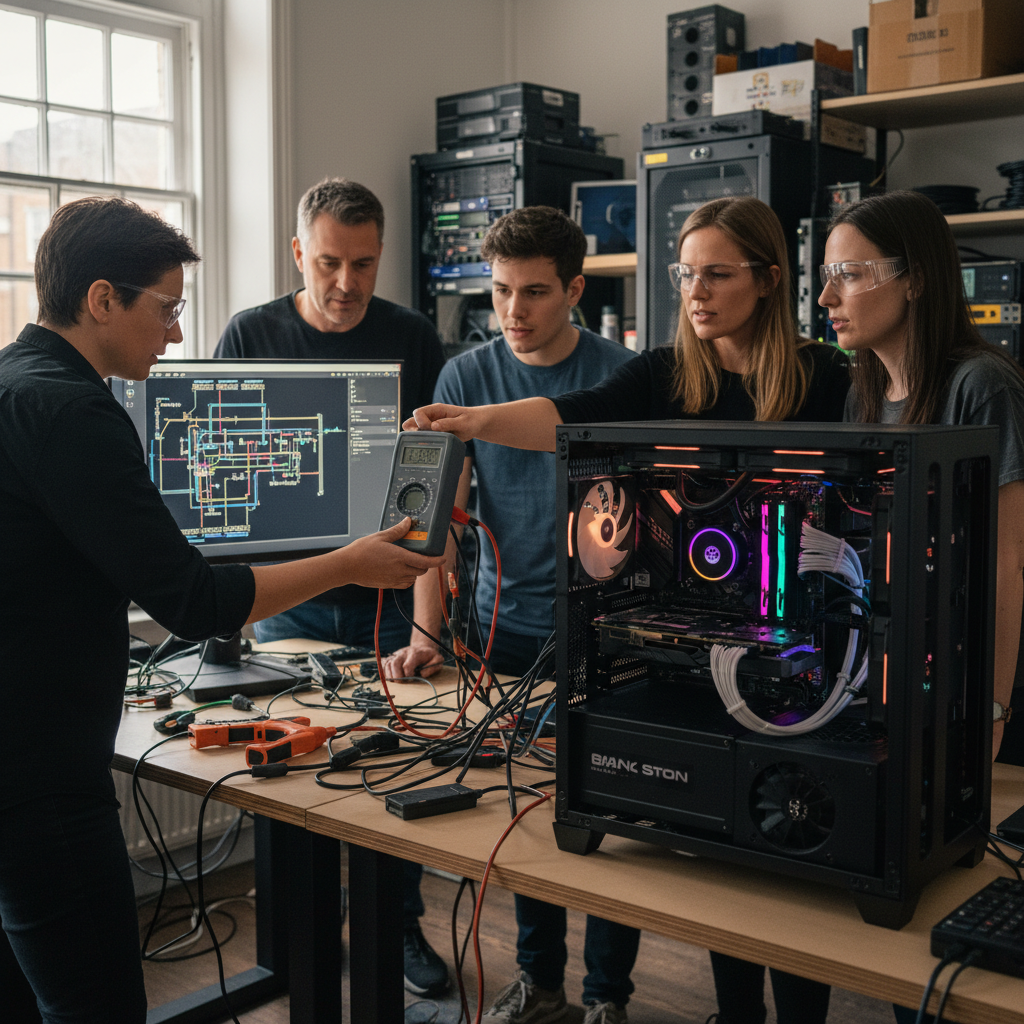
As high-performance computing hardware becomes more accessible to residential users, hobbyists in the Kanawha Valley and beyond are re-evaluating the traditional limits of home electrical setups for specialized machines. The arrival of high-end graphics processing units, such as the RTX 5090, has prompted a surge in community dialogue regarding the precise electrical input required to maximize frame rates and overall system responsiveness at 4K resolutions.
Local hardware enthusiast Jade Skye recently reached out to the community for guidance on maximizing the potential of a high-specification build featuring an AM5 motherboard and a 9850x3d processor. The inquiry focused on the delicate balance of voltage and amperage necessary to push hardware to its absolute peak performance without compromising stability.
Technicians and longtime builders emphasize that many consumer-grade power supply units (PSUs) may actually be a bottleneck for professional-level performance. According to accounts provided to WKNA 49, some advanced users are now looking toward enterprise-level solutions. One local resident noted that high-tier server cases often allow for the installation of multiple 1400-watt power supplies, providing a redundant and robust energy overhead that standard mid-tower cases cannot accommodate.
Technical advisors in the community have even proposed mathematical models to determine ideal wattage based on screen resolution. The so-called 'power matrix calculation' suggests that for those aiming for 4K gaming, the ideal wattage may climb significantly higher than the standard 850-watt units found in most retail stores. While standard home circuits are generally rated for 15 to 20 amps, some enthusiasts are discussing the logistics of much higher draws to maintain maximum efficiency during peak loads.
Beyond simple wattage, some unorthodox suggestions have emerged regarding the physical environment of the hardware. Discussion has touched on specialized liquid cooling and unconventional conductivity methods to manage the intense thermal output associated with high-voltage computing. One resident suggested that for those seeking extreme gains equivalent to 'adding horsepower,' traditional cooling may need to be replaced by fully sealed, specialized submersion environments designed to facilitate rapid energy transfer.
While hardware manufacturers continue to provide standard safety guidelines, the local enthusiast community remains focused on the 'redirect overflow' method of power management. This involves using software commands to specifically divert available wattage to individual CPU cores or memory modules. As computing demands grow, Kanawha Valley residents continue to experiment with these specialized configurations to keep their systems on the cutting edge of modern technology.
Have a news tip? Send it to the WKNA 49 newsroom.